
Why OKRs Quietly Fail at Small Companies (And the Four Fixes That Make Them Stick)

You rolled out OKRs because the best companies in the world swear by them. You ran the kickoff. You wrote the objectives. Everyone nodded. And then, eight weeks later, the spreadsheet is stale, nobody can recite their key results, and the whole thing has quietly evaporated.
You're not alone. Roughly 70% of OKR rollouts fail, and somewhere between 80% and 90% of organizational goals are never actually executed. The framework isn't the problem. The way most small companies adopt it is.
Here's the uncomfortable truth: OKRs don't fail because the idea is wrong. They fail because of four very specific, very fixable mistakes. If you understand why OKRs fail at small companies, you can sidestep every one of them. And turn a tool that usually fizzles out into the engine that finally gets your team executing.
Mistake #1: Nobody Was Actually Trained on the Framework
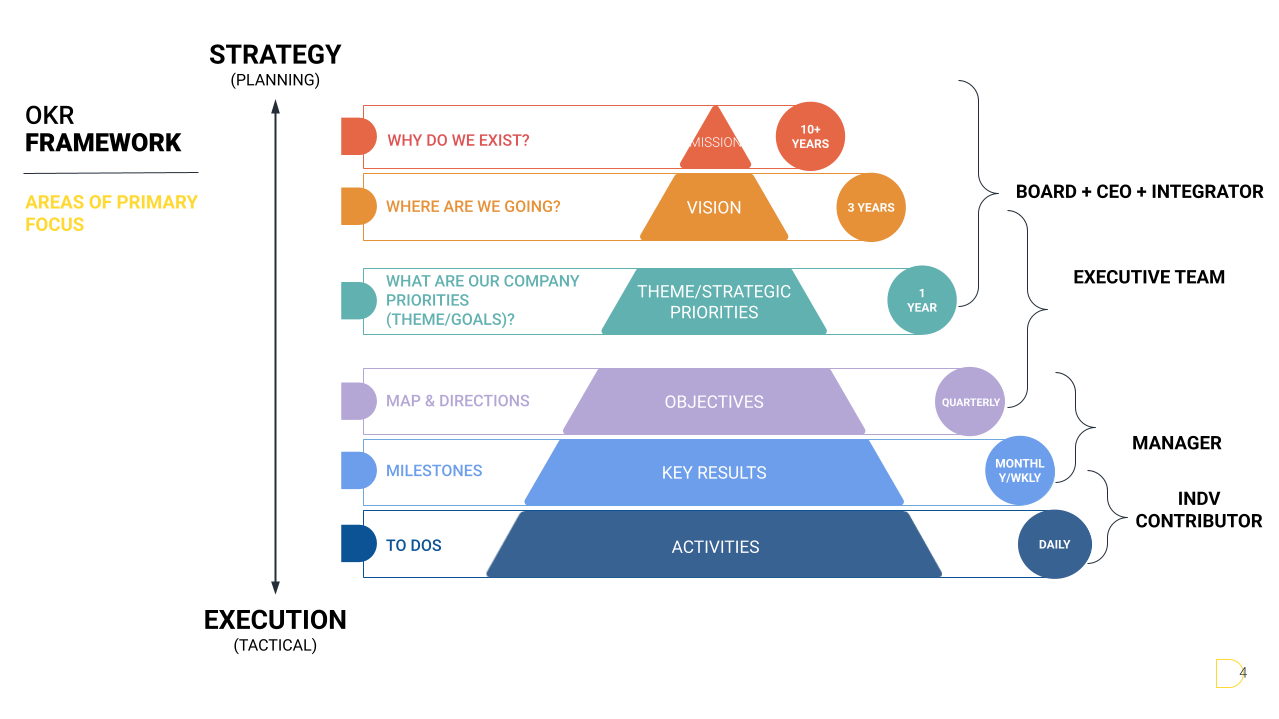
Most founders learn OKRs from a podcast, a LinkedIn post, or a half-read copy of Measure What Matters. That's enough to get excited. It is nowhere near enough to write good OKRs.
So the team produces "objectives" that are really just tasks, and "key results" that are really just a to-do list with deadlines. Most Key Results look like your average to-do list. "Make 5 calls every day" is a task. "Close 5x SMB deals of $400+ MRR through cold calling outreach by August 15th" is a key result. The first measures activity. The second measures whether the activity mattered.
This distinction sounds small. It is everything. A real key result forces a conversation about outcomes, trade-offs, and what "winning" actually looks like. A fake one just renames your task list and changes nothing about how your team behaves.
If your people haven't been genuinely trained, not "sent a link," but coached through writing, critiquing, and rewriting their own OKRs, then you don't have an OKR problem. You have a training gap wearing an OKR costume. Invest the upfront hours. Have everyone draft, then tear the drafts apart together. Bad OKRs written confidently are far more dangerous than no OKRs at all.
Mistake #2: You Gave Up Too Early
This is the silent killer, and it's almost always the founder's fault. Not the team's.
Building a new operating rhythm is hard. The science backs this up: it takes an average of 66 days for a new behavior to become automatic, and in organizational settings, embedding a genuinely new habit typically takes two to five months, sometimes a full six. With an OKR cadence, the planning part only happens once a quarter. To get good at doing this, and really implement the structure, we tell teams this will take a year to a year and a half. You are asking a group of busy people to unlearn how they've worked for years. That doesn't happen in one quarter.
But here's what we see over and over with founders: they try to change too much at once, they fall off the cadence the first time things get busy, or most common of all, they let the team talk them out of it because "this is hard" and "we're slammed right now."
Of course it's hard. Hard is the point. The discomfort you feel in week three isn't a sign the system is broken; it's a sign the system is working on you. The moment you cave and quietly let the weekly review slide, you teach your entire team that the new way is optional. And optional things, in a busy company, always lose.
The founders who win with OKRs are the ones who treat the cadence as non-negotiable for at least two full quarters before they judge it. They change one thing, protect it ruthlessly, and refuse to let "we're busy" become the reason they abandon the very system designed to cut through the busyness.
Mistake #3: There's No Structured Accountability With Real Consequences
This is where almost every small-company OKR program dies. It's also the one most founders are least comfortable fixing.
You can have a beautiful framework and the discipline of a monk, but if nobody is held to their commitments in front of other people, with something real on the line, the OKRs become a wish list. Look at how dramatically accountability changes outcomes:
Just having an idea to do something: 10% likely to happen
Deciding to do it: 25%
Deciding when: 40%
Planning how: 50%
Committing to another person: 65%
Having a specific accountability appointment with that person: 95%
That jump from 65% to 95% is the entire game. It's not the goal that drives execution. It's the standing appointment where you look someone in the eye and report on it. A Dominican University study found people who wrote down their goals and sent weekly progress updates to a peer hit a 76% success rate, versus 43% for those who didn't. Same goals. Wildly different results. The only variable was structured, recurring accountability.
"Real consequence" doesn't mean punishment. It means it matters whether you delivered or not. That there's a moment of truth you can't skip, a peer or a board you've made a promise to, and a genuine reckoning when a key result goes red. When missing your number costs nothing more than an awkward Slack message you can ignore, you've built a suggestion box, not an execution system.
The Fix: A Cadence You Can't Wriggle Out Of
Put these together and the pattern is obvious. OKRs don't need to be more sophisticated. They need a structure around them that makes the four mistakes impossible:
Train properly: Coach your team through writing and rewriting real key results, not tasks in disguise.
Commit to two quarters minimum: Change one thing, protect the cadence, and don't let "we're busy" win.
Build in real accountability: A recurring appointment where commitments are reported and red flags are named out loud.
Add consequence: Make it matter, to a person or a group, whether you delivered.
This is exactly why the rhythm of a great recurring meeting matters more than the framework you write at the top. The OKRs are the what. The standing meeting where every leader reports progress, owns their misses, and gets held to the next commitment by people whose respect they want is the how. Strip away the jargon and that's all a board meeting really is: a structured accountability appointment with real consequence, run on a cadence nobody is allowed to skip.
That's the difference between a team that has goals and a team that hits them.
You Don't Have to Build the Accountability Engine Alone
Most founders don't fail at OKRs because they're not smart enough or disciplined enough. They fail because they're trying to be the source of accountability and the person being held accountable and no one is holding the holder.
That's the gap a strong peer group or coaching relationship fills. It gives you the trained framework, the outside pressure to stay on cadence past the hard part, and the structured appointment with real consequence that turns your OKRs from a stale spreadsheet into the way your company actually runs.
If you're tired of watching good intentions die by week eight, let's fix the system around your goals not just the goals themselves. Book a discovery call at betterboardmeeting.com and let's build you an execution rhythm that actually sticks.