
The Loneliness Tax: What CEO Isolation Is Really Costing Your Business
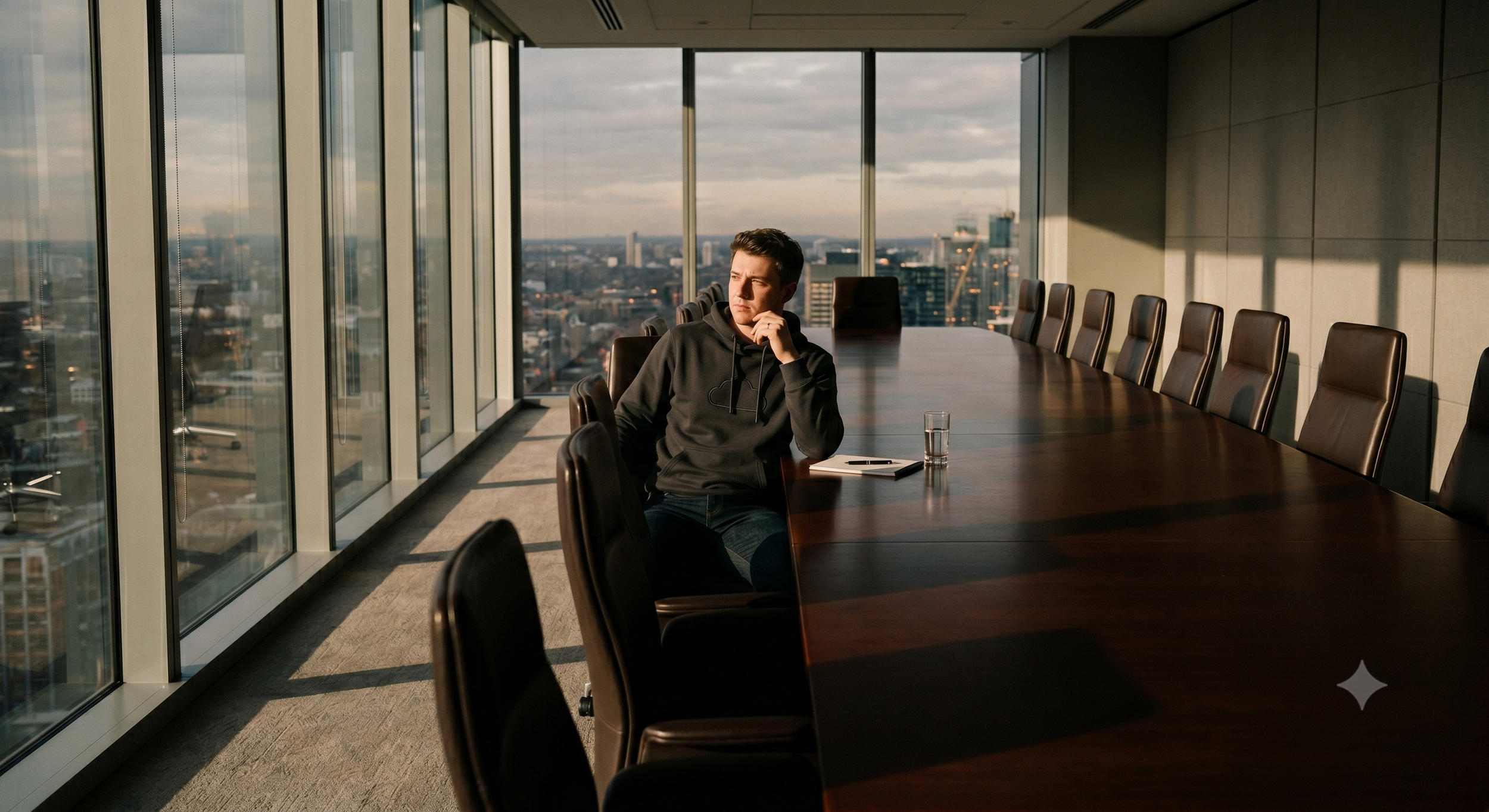
There's a stat that doesn't get enough airtime.
Fifty percent of CEOs report feeling lonely in their role. Sixty-one percent say that loneliness is directly hurting their performance.
Read that again: the majority of people steering organizations, making the calls that shape strategy, culture, and growth, are operating in isolation. And it's showing up in their results.
This isn't a soft, feelings-first problem. It's a business problem. A performance problem. And for most founders and SMB leaders, it's a completely invisible one, because no one talks about it.
Until now.
Why Leadership Is Structurally Lonely
The loneliness of leadership isn't a character flaw. It's a design flaw.
When you run the company, you can't be fully candid with your team. They're watching how you handle pressure. You can't be fully candid with your board. They're evaluating you. Your investors want confidence. Your family wants reassurance. Your friends don't really get it.
So you carry it alone.
This dynamic has a name: executive isolation. It's not ordinary workplace loneliness. It's a structural condition driven by the confidentiality demands, power dynamics, and singular accountability that come with being the one at the top.
And it gets worse over time. The bigger the company grows, the more layers form between you and honest input. The more success you achieve, the fewer people will tell you the truth.
The Hidden Price Tag
Here's where the conversation usually stops being abstract and starts being expensive.
Isolated leaders make worse decisions, not because they're less capable, but because they're working with less input. They're pattern-matching alone, without the benefit of outside perspective or honest challenge.
The data backs this up:
61% of CEOs say loneliness is hindering their performance (Harvard Business Review)
Cognitively diverse leadership teams are 36% more profitable, which means insularity has a measurable cost (McKinsey)
CEO turnover hit a record high through 2025: 1,504 departures, the highest since tracking began in 2002, with even high-performing CEOs leaving at unprecedented rates
26% of executives show symptoms consistent with clinical depression, compared to 18% in the general workforce (McLean Hospital)
The "Loneliness Premium," as researchers at The Alternative Board have framed it, isn't just a wellness issue. It shows up as delayed decisions, missed market windows, higher team turnover (leaders who are burned out and disconnected breed cultures that are too), and eventually, CEO churn itself.
You don't see it on a P&L. But you feel it in your outcomes.
The Loneliness Trap: Why You Don't Fix It
There's a specific reason smart, driven founders don't address this problem: it doesn't feel like a problem they're allowed to have.
You built something. People count on you. You raised the money, hired the team, set the vision. Saying "I feel isolated" feels dangerously close to saying "I can't handle this."
So you don't say it.
You schedule another one-on-one. You push through the weekend. You convince yourself that the next quarter, when things calm down, you'll have time to build out the network. Reconnect with peers. Get some outside perspective.
But things don't calm down. The isolation compounds. And the decisions you make in that vacuum carry the fingerprint of someone working without enough signal.
The Fix Is Not What You Think
It's not a coach (though coaching helps). It's not a mentor (though mentors are valuable). It's not therapy (though that's worth considering too).
The research is actually pretty clear on this: the most effective intervention for CEO loneliness is peers.
Not advisors with a hierarchy. Not networking events with business cards. Actual peers: other founders and executives who are inside the same stage of challenge you are, who understand what it means to make a payroll decision at 11pm, who have nothing to sell you and no incentive to sugarcoat.
Inc. Magazine framed it simply: "The fix is peers. Other founders who get it. People who can say, 'I went through the same thing, and here's what I learned,' without judging you for not having it figured out."
The data on outcomes is compelling:
71% of CEOs who sought peer support reported improved company performance (Harvard Business Review)
Leaders who participate in structured peer mastermind groups outpace competitors by 2.5–5% annually (Dun & Bradstreet)
People with regular accountability partners improve goal achievement rates by up to 95% (Association for Talent Development)
These aren't soft benefits. They're performance multipliers, and they come specifically from the peer dynamic, not from top-down coaching or bottom-up feedback.

What a Real Peer Group Looks Like
Most CEOs who've experienced a well-run mastermind describe it as the most valuable professional investment they've made, and most of them waited five years longer than they should have to join one.
The format that works isn't a happy hour or a LinkedIn group. It's a small, curated group of non-competing executives (typically 6-12 people) who meet regularly (monthly is the standard), hold each other accountable, and operate under a structured framework that keeps conversations honest and high-leverage.
The key ingredients:
Curation over size. A peer group of 8 trusted people who are all operating at your level is worth more than a network of 800. Quality of the room determines quality of the insights.
Psychological safety. The conversations that move the needle aren't the polished ones. They're the ones where someone says, "Here's the thing I haven't told anyone." That only happens in an environment built for trust.
Structure. Good peer groups don't just meet and chat. They use hot seats, structured problem-solving, and accountability check-ins. The structure is what separates a mastermind from a coffee catch-up.
Skin in the game. The best peer groups have a mix of formats: open floor, hot seat presentations, outside speakers. But the unifying thread is that everyone has something at stake. That's what makes the feedback real.
What This Has to Do With Your Board Meeting
A well-run mastermind is, in effect, a better board meeting.
It's the structure you were promised when someone first told you to "build a personal board of advisors." It's the candid input that should happen in your quarterly leadership reviews but usually doesn't. It's the place where the strategy question you've been carrying for three months actually gets stress-tested by people who have earned the right to push back.
Most CEOs have never experienced a meeting, formal or informal, where they were simultaneously held accountable and genuinely supported. Where they could bring the real problem, not the polished version.
That's what changes when you solve the isolation problem. Not just your mood. Your decisions. Your clarity. Your velocity.
You're Not Supposed to Figure This Out Alone
Leadership at the top of an organization was never meant to be a solo endeavor, even though it often feels like one.
The CEOs who grow fastest, make the clearest decisions, and build organizations that actually execute around them have something in common: they've surrounded themselves with people who tell them the truth. Not employees. Not investors. Peers.
If you've been running on your own signal, carrying the weight of decisions in isolation and wondering why clarity feels so hard to find, this is the thing worth fixing first.
The Loneliness Tax is real. And the good news is it's one of the most solvable problems a founder faces.
Ready to stop running on your own signal? Better Board Meeting works with founders and executives to build the peer accountability structures that drive real leadership performance. Book a discovery call at BetterBoardMeeting.com and let's talk about what a better board looks like for you.